
Wondering how long your EV will take to charge?
The honest answer: it depends — on your battery size, your charger type, how empty the battery is, and even the weather outside. Sometimes it's a full overnight charge at home. Sometimes it's a 30-minute top-up at a highway charging station before you get back on the road.
This guide breaks it all down so you can plan better and charge smarter — whether you own an electric scooter, a Tata Nexon EV, or anything in between.
What Does EV Charging Time Actually Mean?
EV charging time is how long your charger takes to add power to your battery from one percentage level to another.
Here's the thing: most EV owners don't charge from 0% to 100% every single day. Just like your phone, you charge based on what you need. Before a long drive, you might top up from 20% to 80%. On a regular weekday, you might only add enough charge to cover tomorrow's commute.
So when we talk about charging time, we're really talking about: how much energy do you want to add, and how fast can your charger deliver it?
How to Calculate EV Charging Time?
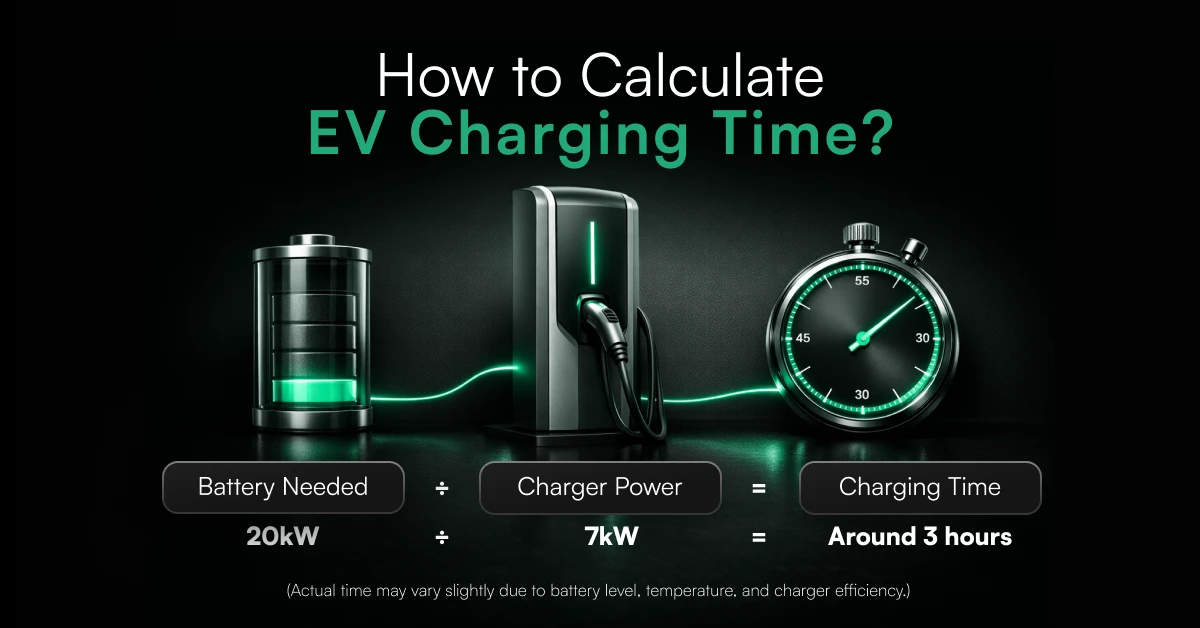
The basic formula is simple:
Charging Time = Battery capacity to be charged (kWh) ÷ Charger power (kW)
Example: Your electric car has a 40 kWh battery. You want to add 20 kWh. You're using a 7 kW home charger.
20 kWh ÷ 7 kW = ~3 hours
That's your estimate. In real life, actual time may vary slightly because chargers don't always deliver their full rated power throughout the session - more on that below.
Why EV Charging Time Is Never Exactly the Same?
Seven things affect how long your EV actually takes to charge:
- Battery size A larger battery holds more energy, so it simply needs more time to fill up — all else being equal.
- Current charge level Charging from 20% to 80% is noticeably faster than pushing from 80% to 100%. After 80%, the EV intentionally slows down to protect the battery.
- Charger power output A 3.3 kW charger and a 60 kW DC charger are not the same thing. Power rating is the single biggest variable in charging speed.
- Your EV's onboard charger limit Even if a station offers 22 kW AC, your car may only accept 7 kW. The vehicle's onboard charger decides the speed ceiling, not the station.
- Battery temperature Lithium-ion batteries work best in moderate temperatures. In extreme heat or cold, the battery management system slows charging to protect cell health. This is especially relevant in Indian summers and hill regions.
- Charger condition and load A faulty, overloaded, or high-traffic public charger may deliver less than its rated power. Always check the charger's live status on its app before heading out.
- Connector compatibility If your EV's connector doesn't match the station's plug type, it simply won't charge. Check compatibility before stopping at an unfamiliar station.
Why Charging Slows Down After 80%?
This surprises many first-time EV owners: the battery doesn't charge at the same speed from 0% to 100%.
Charging is fastest in the middle range - roughly 20% to 80%. Once the battery crosses 80%, the EV's battery management system deliberately reduces charging speed.
The reason is simple: pushing a nearly-full battery hard generates heat and puts stress on the cells. Slowing down protects long-term battery health.
Here is the practical takeaway: at a public fast charger, stop at 80% and get moving. You'll save 20-40 minutes of waiting for that last 20%, which also delivers less range per minute than the first 80%.
Note on LFP vs NMC batteries: Most affordable Indian EVs - Tata Nexon EV, Tata Punch EV, MG Windsor - use LFP (Lithium Iron Phosphate) batteries. For these, charging to 100% daily is fine and doesn't cause the same degradation concerns as NMC chemistry. Premium EVs may use NMC batteries, where the 80% rule matters more.
EV Charger Types and How Fast They Charge
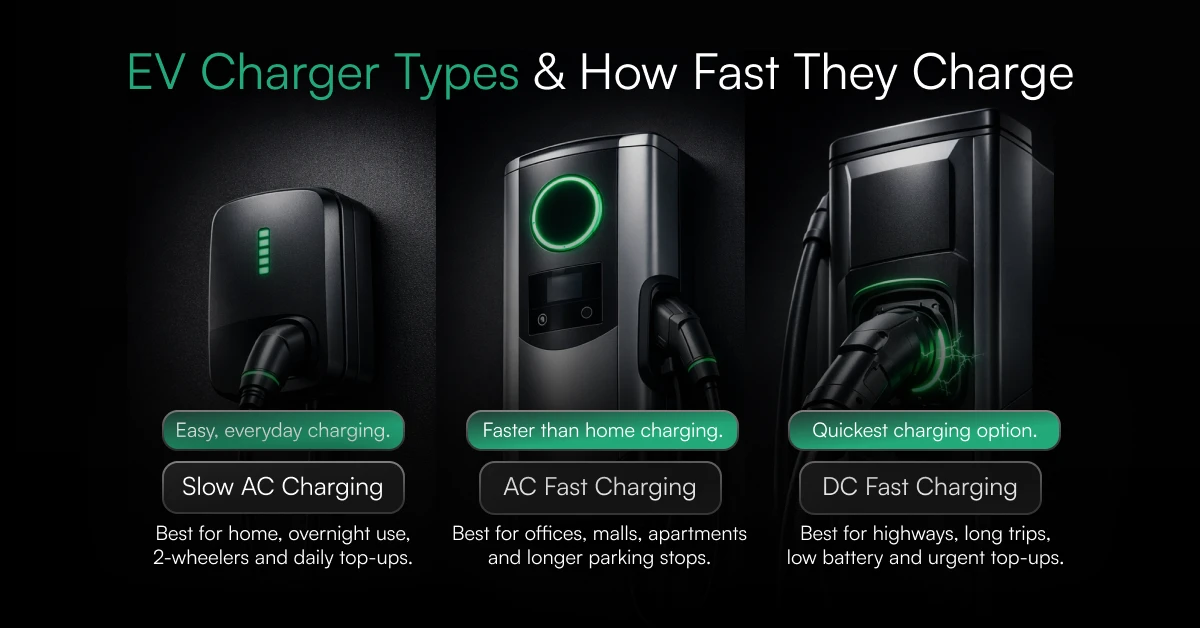
There are three types of chargers you'll encounter in India:
1. Home Charging (Slow AC - Level 1)
The most common setup for daily use. Every EV sold in India comes with a portable charger that works on a standard 15A wall socket — the same socket used by a geyser or AC. No special wiring needed.
- Power output: 2.5–3.3 kW
- Speed: ~12–15 km of range added per hour of charging
- Best for: Daily city use, overnight charging, electric scooters and three-wheelers
- Cost: ₹6–10 per unit at home (most affordable option)
2. AC Fast Charging (Level 2)
Faster than a basic wall socket. Found at homes with wall box chargers, offices, malls, residential societies, and parking lots.
- Power output: 7 kW to 22 kW
- Speed: 2–4x faster than a home socket
- Best for: Office parking, mall stops, apartment charging bays, users who need more speed without going to a public station
3. DC Fast Charging (Level 3)
The fastest option. Found at public EV charging stations, highways, fuel stations, and commercial hubs.
- Power output: 25 kW to 150 kW (some premium stations go higher)
- Speed: 0–80% in 30–70 minutes depending on the EV
- Best for: Long-distance travel, highway stops, low-battery emergencies
- Cost: ₹18–25 per unit (most expensive option)
India charging infrastructure update: As of December 2025, India has 29,151 public EV charging stations — including 8,805 fast chargers. 91% of national highways now have a fast charger within 50 km.
How Long Does It Take to Charge Different EVs in India?
EV TypeApprox. Battery SizeHome Charging (AC)DC Fast ChargingElectric scooter (e.g., Ola S1, Ather 450X)2–4 kWh3–6 hoursNot applicable / model-specificElectric three-wheeler6–10 kWh4–8 hoursFaster on compatible chargersCompact electric car (e.g., Tata Tiago EV)19–25 kWh6–9 hours~45–60 min to 80%Mid-size EV (e.g., Tata Nexon EV, Punch EV)30–45 kWh7–12 hours~45–70 min to 80%Electric SUV (e.g., Hyundai Creta EV, Mahindra BE6)42–80 kWh8–14 hours~30–60 min to 80%Premium EV (e.g., BYD Atto 3, Tata Harrier EV)60 kWh+10+ hours~30–50 min to 80% if supported
Charging times are estimates and vary based on charger power, battery condition, temperature, and the EV's onboard charger rating.
Popular EV Charging Times in India (Model-Specific)
For the most common EVs searched by Indian buyers:
Tip: Your EV's manual and manufacturer app will always give the most accurate charging time for your specific variant and charger combination.
How to Charge Your EV Faster - 7 Practical Tips
Here are the 7 Tips to charge your EV. Well you can reduce EV charging time by planning better, choosing the right charger, and avoiding useless waiting at public charging stations.
1. Don't wait until it's nearly empty Charging from 10% takes longer and is harder on the battery. Plug in when you're around 20–30%. This also gives you flexibility if you forget one night.
2. Use DC fast charging when it matters, not always DC fast chargers are great for road trips and emergencies. For daily use, home AC charging is cheaper and gentler on the battery.
3. Plan your charging stops before a long drive Check real-time EV charging station availability using the MyMotor app on Google Play — it shows live status across 3,000+ stations on one map. Arriving at a working charger saves far more time than driving fast.
4. Stop at 80% at public fast chargers Charging from 80% to 100% at a DC fast charger can take almost as long as going from 20% to 80%. Hit 80%, pay, and go.
5. Charge during off-peak hours at home Several Indian states now offer Time-of-Day (ToD) tariffs where late-night electricity is cheaper. If your utility supports it, schedule charging between 11 PM and 6 AM.
6. Keep your battery between 20% and 80% for daily use This applies mainly to NMC battery EVs. For LFP battery EVs (Nexon, Punch, Windsor), charging to 100% daily is generally fine.
7. Keep your EV software updated Battery management software updates from manufacturers can improve charging efficiency and speed. Check for updates regularly through your EV's app or service centre.
EV Charging Costs in India - Quick Reference
| Charging Type | Cost per Unit | Full Charge Cost (40 kWh EV) | Per Km Cost |
|---|---|---|---|
| Home (AC) | ₹6–10/kWh | ₹240–400 | ~₹1–1.2 |
| Public AC fast charger | ₹8–15/kWh | ₹320–600 | ~₹1.5–2 |
| Public DC fast charger | ₹18–25/kWh | ₹720–1,000 | ~₹2.5–3.5 |
For comparison: a petrol car at 15 km/litre with fuel at ₹105/litre costs roughly ₹7 per km. Even at a DC fast charger, EVs cost 2–3x less per kilometre.
EV charging doesn't need to be complicated. For most Indian EV owners driving 30–50 km a day, a standard home socket charged overnight is all you need. DC fast chargers are for road trips and emergencies - not daily use. Use the MyMotor EV charging app to find verified chargers across India — free on Android.
The key is matching your charger to your routine, knowing your battery type, and planning ahead on longer drives. Once that habit is in place, charging an EV is genuinely simpler than filling petrol.